India has won the World Cup in Cricket. There is euphoria all around. The entire nation is unable to think of any other matter of interest.
People have been talking about Dhoni's leadership qualities. I think there is something there for all of us to be inspired about in our profession. His graciousness, his ability to move away fom limelight, his ability to bring the best in people, his mental strength in doing what he believes in despite public pressure (the whole world wanted Ashwin - he brings in Nehra and Sreeesanth. Dhoni went public saying he misread the pitch - I dont believe it one bit! He was just fooling us! He wanted the discussion to die down! That is clever!) In the corporate world where leadership is a big factor - we can surely use Dhoni-like qualities.
Now for the obnoxious part! I understand winning the World Cup is something special. But why is so much of National Wealth going to only a handful of people? This is national property - our wealth damn it! This is not correct!
Why not give something to Leander Paes and Bhupathy - they are the World No.1 doubles tennis pair you know! Why not our sportspeople who got us Olympic medals? They need it and need it badly!
Lifelong AC 1st class pass for the cricketers from Indian Railways! Why not for our musicians?Do we know how difficult it is to be a full time musician? When it comes to giving a petrol pump to late Ustad Bismillah Khan (Bharat Ratna - a real jewel in India's crown) it is turned down! Now cores of rupees are given as bonus to cricketers! This is just politics! Are all professions encouraged by the Indian Government? Do our poliicians know what it is to be a good musician or a good architect or a good painter or a good writer who can fashion a million minds? Is there a place under the sun for achievers in other spheres? I seriously doubt it! Ah! this attitude! This hurts! Is this a governmernt that wants to take the nation forward.... We have no means to look at the problem in the eye and resolve them -we want cricket diplomacy to solve indo-pak issue! Juvinile! Pathetic!
Why do we go to such ludicrous extent of going to living rooms of circketers and talking to mothers, sisters and relatives? See how the Sri Lankan crowd has handled its disappointment! See how Japanese people have handled tragedy! That is called maturity! When will get there? Will we ever have a sense of equanimity in handling good and not-so-good situations?
Can we do something about this? Can we contribute in a small way to see how We as Indians move to a more matured world?
AKASHVANI SANGEETH SAMMELAN 2015

At Chinmaya Mission Auditorium, New Delip
Monday, April 04, 2011


Friday, March 25, 2011
PADMANABHA SASTRY AWARD FOR ARTS
The family of HR Padmanabha Sastry confers the Padmanabha Sastry Award for Arts every year on musicians. This year we were chosen for the award.
HR Padmanabha Sastry was a renowned music director of Telugu and Kannada movies. He was the first Telugu films music director and composed the music for the first ever Telugu talkie film "Bhakta Prahlada" released in 1931. Our thanks to Smt and Sri HP Ramamurthy (eminent tabla player and son of Late HR Padmanabha Sastry) and their family for this gesture. The function was held on February 27,2011 at Dakshinamurthy Auditorium, Mylapore and the chief guest was senior flute Vidwan Prapancham Sitaraman (disciple of the great Flute Mali).
Tuesday, February 22, 2011
THE DESERT SAFARI
Back from a refreshing concert-cum-sightseeing 5-day trip to Dubai.
First things first. We played a concert for Indian Fine Arts, Dubai on February 18th. The organizers took great care of us, and the event itself was very well put together. Full house crowd. The concert went for three hours. We were accompanied by senior local mridanga vidwan Sri Govindarajan and Sriraam Subbaraman, seasoned Kanjira player also residing in Dubai. As such wherever we do play, we like to present music that is completely classical, and it must be said that in Dubai the crowd was quite knowledgeable, and we did not need to dilute the contents of our presentation. Thank you Indian Fine Arts, Dubai for having us, and of course for the lovely flowers which stayed fresh for the rest of our trip in our room.
About the sightseeing, it was the usual stuff...Dubai Mall, Gold Souk, Museum, Burj Khalifa (the world's tallest building), Burj Al Arab (where Federer and Agassi played a game on the helipad), the desert safari etc. The tremendously impressive landscaping throughout the city....green grass everywhere, flowers.....how do they do it in a desert? Mind boggling. And such clean roads. Also learned that the Dubai branch of a South Indian hotel had to shut down for sometime after the Dubai Municipality guys found a cockroach somewhere in the premises, and this was grossly below their hygiene standards.
What made the trip truly special was the fact that we were able to connect with old friends from music class and school, people we had not met for the last 15-20 years. Most of us reconnected over Facebook. And it was amazing, reliving old memories, chatting about the good old days. It was fantastic!
Posting some concert pictures here. Courtesy, again, a wonderful friend!
First things first. We played a concert for Indian Fine Arts, Dubai on February 18th. The organizers took great care of us, and the event itself was very well put together. Full house crowd. The concert went for three hours. We were accompanied by senior local mridanga vidwan Sri Govindarajan and Sriraam Subbaraman, seasoned Kanjira player also residing in Dubai. As such wherever we do play, we like to present music that is completely classical, and it must be said that in Dubai the crowd was quite knowledgeable, and we did not need to dilute the contents of our presentation. Thank you Indian Fine Arts, Dubai for having us, and of course for the lovely flowers which stayed fresh for the rest of our trip in our room.
About the sightseeing, it was the usual stuff...Dubai Mall, Gold Souk, Museum, Burj Khalifa (the world's tallest building), Burj Al Arab (where Federer and Agassi played a game on the helipad), the desert safari etc. The tremendously impressive landscaping throughout the city....green grass everywhere, flowers.....how do they do it in a desert? Mind boggling. And such clean roads. Also learned that the Dubai branch of a South Indian hotel had to shut down for sometime after the Dubai Municipality guys found a cockroach somewhere in the premises, and this was grossly below their hygiene standards.
What made the trip truly special was the fact that we were able to connect with old friends from music class and school, people we had not met for the last 15-20 years. Most of us reconnected over Facebook. And it was amazing, reliving old memories, chatting about the good old days. It was fantastic!
Posting some concert pictures here. Courtesy, again, a wonderful friend!
Friday, July 09, 2010
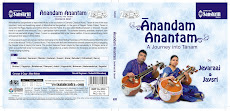
About "ANANDAM ANANTAM" - A Journey Into Tanam
JOY ALL THE WAY, says THE HINDU. Click Here for the entire review.
Manodharma Sangeetham or improvised Music is the touchstone of Carnatic Classical Music. Tanam is one of the most important, lively and bewitching aspects of Manodharma Sangeetham. In the genre of Ragam Tanam Pallavi, Tanam is sung after the Raga Alapana and before entering into the Pallavi. It is also called Madhyamakalam or Ghanam. Though there is no specific time measure (Tala), a perceptible rhythm prevails. Traditionally while singing Tanam, the words ANANDAM and ANANTAM are skillfully interwoven into rhythmic patterns. Tanam is a specialized field in the Veena tradition. It has an extraordinary charm and appeal when played on the Veena.
This product features Tanam played by us in 18 exquisite Ragas, some common, some uncommon and some very uncommon. Not only is this product a ready reference for Tanam singing or playing, its appeal is intended to be universal and could be a wonderful gift to a loved one for any special day.
We would be failing in our duty if we did not thank Sri Pradeep Chakravarty, whose idea it was that we record tanams in various ragas. In fact most of the ragams have been chosen by him. Thanks also to Vedanth Bharadwaj for being the perfect sound engineer. And last but not the least Smt Mala Mohan and others at Swati Soft Solutions for putting this together.
"ANANDAM ANANTAM" was released by Smt Veena Kichlu, Managing Trustee of Pandit Ravi Kichlu Foundation on 27th June at Birla Academy of Art and Culture, Kolkata. The event was organized by Guruguha Sangeeth Sammelan of Kolkata. Vidushi Veena Kichlu's presence as Chief Guest for the CD release was memorable for a very significant reason. Her husband, a highly respected and noted Hindustani Classical Singer, Late Pandit Ravi Kichlu was instrumental in bringing out our very first audio release with HMV, titled VEENA DUET, in the year 1992. It was wonderful that she could come and stay back to listen to our concert that day.
Anandam Anantam is a 2ACD pack, available now in leading music stores and also can be bought online through Swati's website - Click Here. We sincerely hope you will add it to your collection. Please do write to us and let us know your thoughts. The list of ragas on each CD is given below.
Disc - 1
1. Hindolam
2. Keeravani
3. Mandari
4. Kedaram
5. Huseni
6. Atana
7. Bahudari
8. Chitrambari
9. Navroj
Disc - 2
1. Bhairavi
2. Yagapriya
3. Balahamsa
4. Dhanyasi
5. Arabhi
6. Vegavahini
7. Mohanam
8. Nadanamakriya
9. Bageshri
Manodharma Sangeetham or improvised Music is the touchstone of Carnatic Classical Music. Tanam is one of the most important, lively and bewitching aspects of Manodharma Sangeetham. In the genre of Ragam Tanam Pallavi, Tanam is sung after the Raga Alapana and before entering into the Pallavi. It is also called Madhyamakalam or Ghanam. Though there is no specific time measure (Tala), a perceptible rhythm prevails. Traditionally while singing Tanam, the words ANANDAM and ANANTAM are skillfully interwoven into rhythmic patterns. Tanam is a specialized field in the Veena tradition. It has an extraordinary charm and appeal when played on the Veena.
This product features Tanam played by us in 18 exquisite Ragas, some common, some uncommon and some very uncommon. Not only is this product a ready reference for Tanam singing or playing, its appeal is intended to be universal and could be a wonderful gift to a loved one for any special day.
We would be failing in our duty if we did not thank Sri Pradeep Chakravarty, whose idea it was that we record tanams in various ragas. In fact most of the ragams have been chosen by him. Thanks also to Vedanth Bharadwaj for being the perfect sound engineer. And last but not the least Smt Mala Mohan and others at Swati Soft Solutions for putting this together.
"ANANDAM ANANTAM" was released by Smt Veena Kichlu, Managing Trustee of Pandit Ravi Kichlu Foundation on 27th June at Birla Academy of Art and Culture, Kolkata. The event was organized by Guruguha Sangeeth Sammelan of Kolkata. Vidushi Veena Kichlu's presence as Chief Guest for the CD release was memorable for a very significant reason. Her husband, a highly respected and noted Hindustani Classical Singer, Late Pandit Ravi Kichlu was instrumental in bringing out our very first audio release with HMV, titled VEENA DUET, in the year 1992. It was wonderful that she could come and stay back to listen to our concert that day.
Anandam Anantam is a 2ACD pack, available now in leading music stores and also can be bought online through Swati's website - Click Here. We sincerely hope you will add it to your collection. Please do write to us and let us know your thoughts. The list of ragas on each CD is given below.
Disc - 1
1. Hindolam
2. Keeravani
3. Mandari
4. Kedaram
5. Huseni
6. Atana
7. Bahudari
8. Chitrambari
9. Navroj
Disc - 2
1. Bhairavi
2. Yagapriya
3. Balahamsa
4. Dhanyasi
5. Arabhi
6. Vegavahini
7. Mohanam
8. Nadanamakriya
9. Bageshri
Tuesday, June 15, 2010
BACK TO THE PAST

Was rummaging through some old papers and found this! An invite for our CD release function in the year 2000, as well as copy of Mudhra Newsletter featuring us. This CD called "Subramanya" comprises of some select compositions of Muthuswamy Dikshitar on Lord Muruga. This CD probably is not available in the stores any more. We have put up some of the tracks on our website www.veenajj.com. The music from the entire CD is available for download through the link given below.
PS: Of course, we have subsequently changed the way we spell our names!! Everything else remains the same!
Click here to download "Subramanya"
THE NEWSLETTER PUBLISHED IN OCTOBER 2000


Friday, April 23, 2010
RECOGNITION FOR EX-CALCUTTANS


We all respect our elders, and our admiration for them increases when they achieve such feats as to make themselves shining examples for generations to follow………… the happiness is manifold when they are people who you have known closely. It gave us great pleasure and a tremendous sense of pride to see the front page articles in The Hindu Friday Review, on two people who we have known since our Calcutta days. First up, Smt Bhuvana Natarajan, Bhuvana mami to us, who has been honoured with the Sahitya Academy award for Tamil translations of Bengali works, in particular of Asha Purna Devi. Amazing! And just today The Hindu Friday Review carried an article on Sri N Gopala Sundaram, who has translated the entire Tiruppugazh in English, and this has been brought out in the form of a book titled “The Glory of Lord Muruga.” We are sure to get Gopal Mama’s autograph on our copy.
Please see below the links to the respective articles:
Grand Culmination
Stupendous Work
Please see below the links to the respective articles:
Grand Culmination
Stupendous Work
Monday, March 15, 2010
THEMATIC CHAMBER CONCERT
A Thematic Chamber Concert was presented under the auspices of our organization Veenavaadhini, based on the Bhooloka Panchalinga Krithis of Muthuswamy Dikshitar. All the Kritis, representing the five elements i.e. space, air, fire, water and earth were sung and played by us on the veena. Sri Trichur Narendran accompanied us on the mridangam. Rajani Arjun Shankar provided word-by-word meaning and narration to each of the krithis. The background comprising of paintings of the great genius Late S Rajam, pictorially depicting each of the kritis, were made by Aparna Shankar. The two-hour programme consisted of the following kritis:
1. Ananda Natana Prakasam – Kedaram – Akasha Kshetra (SPACE)
2. Sri Kalahastisha – Huseni – Vayu Kshetra (AIR)
3. Arunachalanatham Smarami – Saranga – Agni Kshetra (FIRE)
4. Jambupathe –Yamuna Kalyani – Appu Kshetra(WATER)
5. Chintayamakandamula – Bhairavi – Prithvi Kshetra(EARTH)
The Hindu, Mylapore Times and Kutcheribuzz carried a byte about the programme. It was well attended and well received, and we are enthused to present more of such programmes in the near future. We thank all the rasikas for having attended the concert and making it a big success. And thanks Arjun for the pictures, and Parameswaran and Latha for video recording the event!
Given below are reactions from some rasikas who had attended the programme:
"I attended the chamber concert and it was really memorable. A dedicated presentation by the vainika-s. Special mention must be made of Smt Rajani's commentary which gave lot of insight into the supreme compositions of Dikshitar. It was a n excellent idea to have veteran S Rajam's paintings (of Panchalinga) in the background.
The efforts put in by JJ to internalise the kritis and presenting them authentically in Veena, was quite evident in their rendering.
Trichur Narendran's Mridanga support was something special and enhanced the aesthetic appeal.
I rate this among the best thematic concerts of the season!"
-----------------------------------------------------
"The narration, AlApanA-s, tani, and, above all, kRti renditions that adhered to MD sampradAya, were all excellent. It was especially pleasing to listen to chintayamAkandamUlakandam in grand chowkam, with the first line ending on M rather than the usually-encountered version."
-----------------------------------------------------
"It was a very nice concert. In fact, with narration and posters about each piece, it was a whole project rather than just a concert. Everyone had put in a lot of work for the benefit of the listeners.
Each piece was in a slow speed, making a contemplative atmosphere for the entire performance. Trichur Narendran never made any effort to hurry things along, but contributed to the mood perfectly.
The program was well attended, with the room being full, but not uncomfortably so; just right.
As a note of curiosity: not one song was in Adi Talam, which must be a very rare event. Misra, Khanda and Rupaka talams were represented."
-----------------------------------------------------
"A wonderful evening wherein everything fell in place. Jaysri's Yaman Kalyani alapanai was superb and was within the framework of Jambupathe. Jeyaraj played a lovely Bhairavi preceding chintayamAkandamUlakandam and also a brief tanam. Smt Rajani Arjun Shankar's narratives were well researched and crisp. Trichur Narendren is a class apart. His accompaniment was apt for the occasion and considering the fact that all the kritis were slow paced, he controlled the pace admirably."
Saturday, February 27, 2010
ARTICLE IN "AMUDASURABHI" MAGAZINE

Anuradha Kannan of Podhigai TV fame recently authored an article for the reputed Tamil Magazine AMUDASURABHI titled "Karuviyum Kalaingargalum," featuring various carnatic artists and their relationship with the instrument they played. We were asked to write about our bonding (more appropriately, obsession!) with our veenas. Given below is our writeup in English from which has Anuradha interpreted the piece for the article.
VEENA AND US
Ever since we remember, music has been a part and parcel of our lives. During the impressionable stage of our lives, we had been exposed to music steeped in aesthetics and classicism.
Veena has had a revered place in our families and hence it was no surprise that we decided to take up the instrument as a vehicle for our musical expression.
Due credit should go to our revered teachers who have given us a completely unique perspective of the mother of all instruments – the Veena.
To us this instrument has ceased being an inanimate object for long. It is our best friend and it actually “talks” to us every day. It seeks constant pampering. If we fail to practice for a day, there is a sense of discomfort when we play on the instrument the next day. It feels as if the instrument seeks not to respond to our touch!! It needs coaxing and cajoling before it starts responding.
However when we are stressed or troubled, it is our Veena that we turn to. During such times of distress, playing the Veena gives us a lot of comfort and restores equanimity and peace. Surprisingly, under such stressful conditions, it is our friend that sympathizes with us; it needs no coaxing at that point. Playing the Veena becomes a completely de-stressing activity and the environment is filled with positive energy.
When you have such a friend, one would like to increase its tribe. Not surprisingly we have acquired a number of Veenas over the years, and many of these acquisitions can be aptly described as “impulsive”. But we have no regrets in indulging in such an impulsive act!!
Each instrument that we have is very, very special. Our music room is filled with a variety of Veenas, mostly the Tanjore variety. We have indeed built a family of Veenas.
There is one particular Veena that was presented by a music connoisseur for a token amount of Re 1. It is a Tanjore Veena and is more than a century old. It is embedded with ivory strips and the Veena has a unique tonal quality of its own. We are very partial towards this instrument and do not encourage anyone to touch the same. It is only available as a visual treat. Such is our attachment to Veenas that our possessiveness leaves our kith and kin, often, a trifle embarrassed!!
The need for enhanced sound and portability made us look to avenues whereby we could use electronics in a more purposeful manner. In this endeavor, we found great enterprise in Radel Electronics, who have created the Sunadavinodini, an electronic and portable version of the Saraswathi Veena. We have been using this instrument for our concerts in India and abroad. The public response has been very positive and we have had a number of impromptu Q&A sessions on this with members of the audience, particularly from the overseas communities.
However, when we play in solitude in our prayer room we use the original acoustic veena(without the contact mike) but for a concert, as professionals it is our duty to ensure that the clarity and volume of sound reaches every nook and corner of the auditorium and for us the electronic veena has been a boon.
Though we keep indulging in our hobby of collecting veena there are some identified ones which are handled specifically by one of us. They are more a personal possession and are seldom used by the other - not even during practice. This brings more familiarity to the instrument. We are not comfortable with outsiders touching or playing our instruments but we do make an exception for our own students and allow them to play on some of our Veenas especially during concert engagements.
Our Veenas are our treasure. There is an inextricable bond. Veenas, by design, are very fragile and one needs to spend a lot of time and care in keeping them clean and in perfect tune. They demand a unique sense of responsibility from you. Not a single day goes by without our realizing how much our veena has enriched our life, right from bringing us together as life partners, to giving us the opportunity to serve the cause of Carnatic music in our own small way. It thus goes without saying that our Veenas are and will always remain our best friends forever.
Wednesday, January 13, 2010
OBITUARY

January 5, 2010 was one of the saddest days for the carnatic community. Veena Vidwan Trivandrum Venkataraman died in a car accident. He was one of the all-time great vainikas. For a man of such great vidwath and capabilities, he was a very humble and unassuming person indeed. Everytime we met, he would treat us with a lot of warmth and a personal touch that was very unique to him. We will definitely miss him. Even as we write this, we are still to come to terms with this cruel act of fate. He received the Sangeetha Kala Acharya this year from the Music Academy just a few days before his death. May his soul rest in peace. Our deepest condolences to his family and his sishyas.
Friday, November 13, 2009
VEENA FASHIONISTAS?
We consider ourselves lucky for having got an opportunity, 15 years ago, to settle down in Chennai. Understandably so, since purely from the Carnatic Music performer's perspective, this has always been the place to be. And, we have come a long way, from those times of fighting our disillusionment on the veena scene in the then Chennai concert circuit, to now, where almost everyday a veena concert is happening somewhere in the city. What we need now is to gather more momentum and keep it going. There should be more people coming to listen to veena concerts not because "they feel the need to do their bit to encourage veena players" but purely because they feel this is what they would like to hear on a particular evening. The onus is very much on us to take it to that level. Aural pleasure is important. In the days of yore, veena was the only instrument known, so it might have enjoyed great monopoly. But now, there are so many more, which with their volume advantage are capable of instantaneously connecting with the average rasika. The veena losing out to the violin as an accompanying instrument is a case in point here. As vainikas, we also have another humungous responsibility....to preserve the gamaka-laden purity of carnatic music for which veena is the singular point of reference, particularly when it comes to Dikshitar Kritis. Over and above is the size of the Saraswathi veena, which itself daunts the organizer (who may be laden with the responsibility of transporting the artist and his/her veena from the airport, etc). He is probably thinking whether getting a van/truck to carry the instrument is worth the effort, or should he settle down to arrange some other concert which requires less paraphernalia. We have heard mridangam vidwans telling us that they have had real tough times lifting huge veena boxes while on overseas trips with lady veena artists!
In the past few years we have found a reasonable solution to these issues. We have been using the electronic veena. We are happy. We have not had to sacrifice the "vadya dharma." We have not felt the need to play something that we do not want to, just because it "sounds good" and instantly makes the average rasika connect. People in the audience do not have to guess what we are playing. They can hear. The mridangist does not have to tone down his volume to inaudible levels so as not to drown the music of the veena. We can carry/transport our instruments to anywhere in the world without much ado. All this ....... not because it is "modern" or we are some "veena fashionistas"..... but only because we want more people to be able to comfortably hear what is being played, not having the necessity to compromise on what is deemed classical, with the hope that not just "veena rasikas" but "all rasikas" of Carnatic Music can identify with music produced on the veena and connect with it. Clearly, we are using the option because it is available now, and it wasn't earlier.
Reproduced below is our letter published in The Hindu Friday Review as a rejoinder to a few lines published in a recent review of a young veena artist's concert. Also is given the link to our interview for Radel's Newsletter on our thoughts on the electronic veena and other related topics.
THE LETTER
Veena’s tonal quality
This is with reference to the review of Bhavani Prasad’s veena recital (Friday Review, September 4). We refer to a section where the writer has expressed the desire to see the traditional Saraswathi Veena being used increasin gly on the concert stage. The sound produced by a Saraswathi Veena is undoubtedly unparalleled in terms of melody. However, this is true only if the veena is used in its pristine form (i.e. no contact mike). The moment one uses a contact mike, the sound is no longer a result of its resonance from the hollow of the ‘kodam.’ It may be interesting to note that two veenas using the same microphone may produce a sound that may be as different as chalk and cheese. We are yet to see a perfect contact microphone that highlights the right tonal qualities of a Saraswathi Veena, with the exception of perhaps the instrument used by the great Vidwan S. Balachander. To reach out to a large audience, we have turned to the electronic veena as sufficient amplification is possible without much ado; tonal quality can be fine-tuned to suit the artist’s need; in case of a duet, the tonal representation of the two veenas is similar; and, the instrument can be easily transported.
Jaysri and Jeyaraaj
Chennai
The Radel Newsletter Interview - Click Here
In the past few years we have found a reasonable solution to these issues. We have been using the electronic veena. We are happy. We have not had to sacrifice the "vadya dharma." We have not felt the need to play something that we do not want to, just because it "sounds good" and instantly makes the average rasika connect. People in the audience do not have to guess what we are playing. They can hear. The mridangist does not have to tone down his volume to inaudible levels so as not to drown the music of the veena. We can carry/transport our instruments to anywhere in the world without much ado. All this ....... not because it is "modern" or we are some "veena fashionistas"..... but only because we want more people to be able to comfortably hear what is being played, not having the necessity to compromise on what is deemed classical, with the hope that not just "veena rasikas" but "all rasikas" of Carnatic Music can identify with music produced on the veena and connect with it. Clearly, we are using the option because it is available now, and it wasn't earlier.
Reproduced below is our letter published in The Hindu Friday Review as a rejoinder to a few lines published in a recent review of a young veena artist's concert. Also is given the link to our interview for Radel's Newsletter on our thoughts on the electronic veena and other related topics.
THE LETTER
Veena’s tonal quality
This is with reference to the review of Bhavani Prasad’s veena recital (Friday Review, September 4). We refer to a section where the writer has expressed the desire to see the traditional Saraswathi Veena being used increasin gly on the concert stage. The sound produced by a Saraswathi Veena is undoubtedly unparalleled in terms of melody. However, this is true only if the veena is used in its pristine form (i.e. no contact mike). The moment one uses a contact mike, the sound is no longer a result of its resonance from the hollow of the ‘kodam.’ It may be interesting to note that two veenas using the same microphone may produce a sound that may be as different as chalk and cheese. We are yet to see a perfect contact microphone that highlights the right tonal qualities of a Saraswathi Veena, with the exception of perhaps the instrument used by the great Vidwan S. Balachander. To reach out to a large audience, we have turned to the electronic veena as sufficient amplification is possible without much ado; tonal quality can be fine-tuned to suit the artist’s need; in case of a duet, the tonal representation of the two veenas is similar; and, the instrument can be easily transported.
Jaysri and Jeyaraaj
Chennai
The Radel Newsletter Interview - Click Here
Subscribe to:
Posts (Atom)